

Sounds of planes, bombs, sirens, and tears fill the news each evening. Hospitals are overflowing with injured. Hundreds of displaced families attempt to find safe locations in which to drop their meager belongings and feed their children. War is terrible. Will there ever be PEACE throughout our world?
During a recent trip down the Danube found us visiting a gigantic market in Novi Sad, Serbia. The variety of foods and cooking supplies in these international markets often is exciting but a bit overwhelming. Every color of the rainbow greeted my eyeballs.
Some products grew above ground, others under the soil, and some hung from trees. Multiple types of weather and care were needed for successful produce. Their composition, feeling, and taste were unique, varying from the sweet, juicy peach, to the hard shelled, seedy squash. Some items were key ingredients for major dishes, while other products provided seasoning or support to the key components.
As I wandered among the array of various colored and textured fruits and vegetables, a crazy thought entered my head. Wouldn’t it be wonderful if nations, politicians, school mates, couples, and even angry dogs or warring birds could live side-by-side, mixing and adapting their unique beliefs, needs, and desires? Of course, the potato or onion, blended in a stew, give away some of their uniqueness, but the final product is a peaceful, delicious product. Is it impossible in our twenty-first century to learn how to share, compromise, and give-and take just a bit?
Somehow both professional chefs and ‘fly-by-the-seat-of-your-pants’ cooks manage to chop, slice, dice, blend, season and heat conglomerations of edibles into delicious meals. The results are almost magical, but so appreciated.
Psalm 133:1 gives a resounding scream for peaceful relationships. “How good and pleasant it is when God’s people live together in unity.”
Paul certainly is encouraging followers of The Way to thoughtful interaction with each other. “Finally, brothers and sisters, rejoice! Strive for full restoration, encourage one another, be of one mind, LIVE IN PEACE. And the God of love and peace will be with you” (2 Corinthians 13:11). Of course, this is a challenge. It is a double challenge when reaching out to people of various nations, ethnic, and religious groups, but the basic principle is a worthy and essential goal in our world. There will be necessary chopping, slicing, and blending of ideas and wants as conflicting parties attempt to find peace, but what joy can result as part of that blending and giving up some personal requests and desires.
While in Romania, we also participated in a wonderful lunch prepared by local women of a small village church near Brasov. As we arrived, a large, black, iron pot, containing chicken and various vegetables, was bubbling over a small, outdoor fire. Two cooks were adding to the mix. A thickening substance was stirred in. Then the special ingredient, so commonly found in the foods of this country, was sprinkled over the surface. Some of you may anticipate that final touch — paprika.
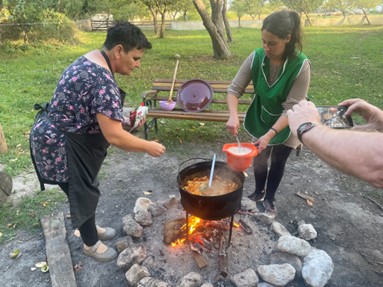
Perhaps we can make one additional connection in our cooking and peace analogy. As the first mouthful of the steaming Chicken Paprikash conglomeration hit the tongue, my tastebuds did a little jump. Yes, the chicken tasted like cooked chicken, but what a tasty surprise the seasoning added to our eating enjoyment. These competent cooks knew how to blend, stir, mix, add, and in a sense, negotiate with probably at least ten different food ‘personalities’ in order to provide moments of ohh’s and ahh’s from the guests. This cooking magic took testing and practice over years of working together with the stew’s content.
Peace in our world, churches, families, offices, and among people of a variety of beliefs will only happen as we learn to communicate with willingness to give up a few of our own preferences and wishes. That thickening in the stew brought the individual food components in closer contact with each other. In a sense, they blended together. In world and local peace negotiations, skilled negotiators may need to apply and add words and suggestions that help unite the quarreling parties to moments of agreement.
Undoubtedly final decisions leading to peace and good will toward others will have a few elements that make the final decision taste like the paprika in my mouth that day in Romania. I knew that something different was biting my lips. I made a quick mental adjustment in my thinking and then, WOW! Pleasantness over-rode the old vision of how chicken might taste sometimes. I gave up the familiar for the new stew.
In response to my opening question, wondering if there will ever be peace everywhere in the world, the answer is probably no until the Lord comes again. Regardless, the scripture certainly encourages each of us to work toward peaceful relationships. Peace between disagreeing parties will necessitate adjustments by all involved. Won’t you join me in prayer for peace for many troubled spots and individuals in our world?
Romans 14:19 sums up a goal for each of us.
“Let us therefore make every effort to do what leads to peace and to mutual edification.”
 Kathryn Ransom